
What Civilization VII Shows You About Power
The game strips away the moral theatre and puts the mechanics of how states actually behave right in front of you. Once you see it, you can’t unsee it in the real world either.

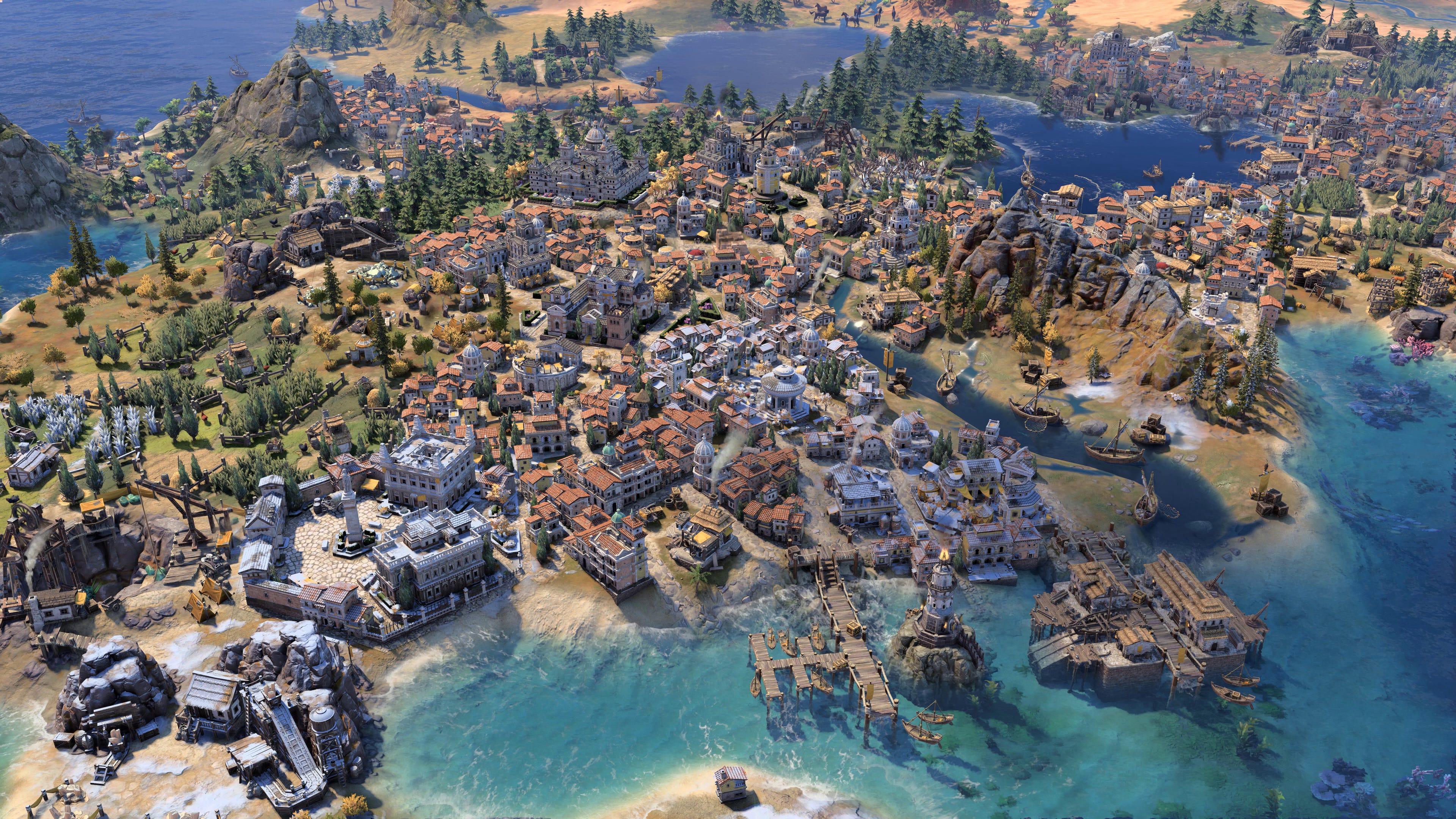
I’m about to betray every leader I’ve spent fifteen hours being friendly with in my current Civilization VII campaign, and the only thing I’m feeling about it is mild strategic satisfaction. Which is, when you stop and look at it, the single most useful thing this game teaches you.
It’s a game. But the lesson it delivers about how power actually works is something most people never get from reading the news. The news gives you the speeches, the justifications, the moral framing. The game gives you the spreadsheet underneath... and you realize the spreadsheet was always doing the driving.
Right now I’m eyeing up pieces of land that don’t belong to me, keeping every leader on the board reconciled and chatty, building my military in the background, and waiting for the right moment to strike. I’ll take what I want when I’m ready. They won’t see it coming because they can’t, I’ve been too agreeable for them to read the shift.
The code you’re running was written by someone else
I started as Caesar of Rome. Over the course of the campaign I evolved into the American Empire, democratic by design, multicultural by definition. We rose out of Europe, took the whole continent, and then looked outward.
That arc matters and it goes deeper than “founding fathers quoting Cicero.” The specific inheritance worth paying attention to is the civic virtue problem. Rome’s Republic collapsed because the thing actually holding it together was a shared belief that public service mattered more than private gain, and the institutions only worked as long as that belief held. When luxury, spectacle, and personal ambition replaced civic duty, no amount of institutional scaffolding could save the Republic. It became an empire because the citizens had already stopped behaving like citizens.
America’s founders read this history and tried to build institutions that could survive human nature being exactly what it is. They partly succeeded. But the Republic-to-Empire drift is the same pressure now, just on a longer clock. Rome ran out of money to fund the wars its Senate kept authorizing, so it debased the denarius, clipping the silver content down decade after decade until the currency was nearly worthless. The US is running the slower version of that through deficits and monetary expansion, eroding the dollar’s purchasing power rather than admitting to voters that the math doesn’t work. Different mechanism, same civilizational admission... that a state which can’t pay for what it wants starts quietly charging the cost to the people who trusted the currency.
Civ makes you feel this continuity because you’re playing it forward yourself. You start lean and civic-minded because you have to, then you get rich, then you get decadent, then the rules start bending to whoever has the most stuff. Every major civilization is running code written by the ones that came before. The language changes. The logic doesn’t.
Diplomacy runs on reciprocity, until it doesn’t
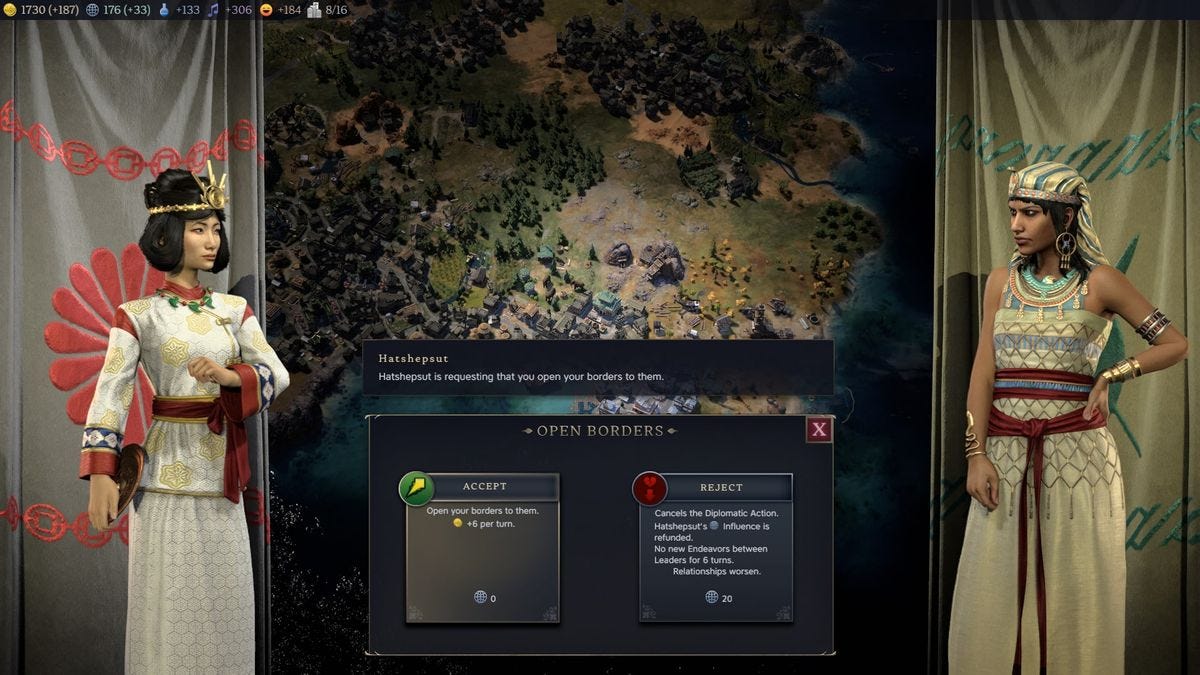
Across every campaign I’ve played, the pattern holds. The leaders who were agreeable, I never attacked, and they never attacked me. The ones who were less agreeable would eventually come at me, and I’d respond with the sword.
That’s close to how international relations actually work. Robert Axelrod ran tournament simulations decades ago and found that tit-for-tat, cooperate by default, retaliate when attacked, forgive when the other side comes back, beats almost everything else in iterated games. The agreeable leaders in Civ are basically running that strategy without knowing it.
The real world does run on this logic, but it’s messier than the model suggests. The US and Canada get along because there’s a stable equilibrium that benefits both sides and neither has an incentive to break it. Shared values are a story layered on top of the incentives to make the equilibrium feel like a friendship. But it would be sloppy to say reciprocity explains everything, because international relations aren’t clean iterated games with symmetric payoffs. Geographic reality matters. Military asymmetry matters. Economic integration creates dependencies that change the calculus in ways a simple tit-for-tat model can’t capture. Canada and the US aren’t cooperating because they ran the math on defection costs, they’re cooperating because the geography, the trade flows, and the power differential make defection basically unthinkable for one side and pointless for the other.
Civ actually shows you this too, if you’re paying attention. The AI leaders who cooperate with you aren’t doing it because your diplomacy score is high. They’re doing it because you’re strong enough that attacking you would be stupid. The cooperation is downstream of the power, not upstream of it.
The command chair changes whoever sits in it
This is the part of the game that sits with me the most, and it’s the part I think about when I read about real wars.
When you’re playing, you’re not thinking about individual units, you’re thinking about the civilization. You weigh the risks, you calculate the return, you send the order. There’s no emotional attachment to the soldiers because they’re abstracted into production numbers and movement points. You click the attack button and the numbers go down. You don’t hear anything.
The uncomfortable thing Civ makes you understand is that this abstraction is how governance works at scale. You cannot run a civilization while feeling every soldier’s death. The math of running anything larger than a tribe requires treating people as variables. A general who feels every loss can’t deploy anyone. A president who internalizes every casualty can’t make decisions. The detachment is the role producing the person, the chair reshapes whoever sits in it, and the math doesn’t get done unless that reshaping happens.
Which leads to a paradox that mostly doesn’t get named. The people most capable of carrying moral weight are usually the people least capable of making the decisions that need moral weight carried. The command chair selects for people who can do the math without feeling it. If it didn’t, the civilization would be paralyzed.
Civ puts you in that chair for fifteen hours at a time and you don’t even notice the switch happening. You just click the button.
Now, the game is also flattering you here, and it’s worth being honest about that. Civ gives you perfect information, rational actors, clean feedback loops. Real statecraft is messier. You’re making decisions with bad intelligence, political pressures the game doesn’t model, institutional inertia, domestic constituencies pulling in six directions at once. The game teaches you the logic of the command chair, but it underestimates the fog. Still, the core insight holds... the seat changes the person, and pretending otherwise is how you get blindsided by what leaders actually do once they’re in it.
Nukes are the only currency that doesn’t inflate
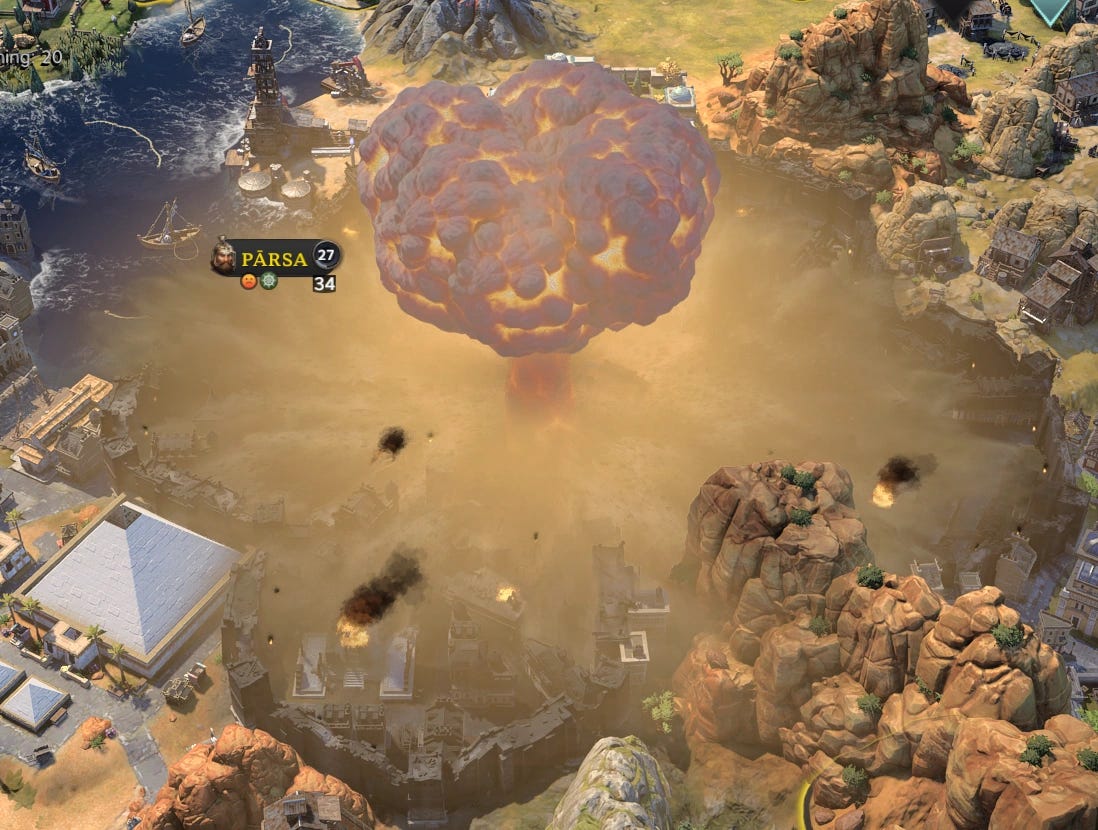
Once I had nukes, the whole game changed. I’d drop one, and whichever civ was on the receiving end would summit. The rest of the board hated me for it, but hate is a soft currency and nukes are hard currency.
Thomas Schelling wrote about this in Arms and Influence, and the distinction he drew matters. Deterrence is defensive, you convince someone not to attack you because the retaliation would be unacceptable. Compellence is offensive, you use the threat to force someone to change their behavior, do something they wouldn’t otherwise do. Both rely on the bomb existing, but they work differently and they fail differently. Deterrence is relatively stable because both sides benefit from not acting. Compellence is inherently unstable because you’re actively demanding change, and the other side has to decide whether you’re bluffing.
North Korea figured out the deterrence half. They got nukes and the whole calculus shifted, nobody’s invading them, and they know it. That’s why they’ll never give them up. But their ability to compel is limited, they can stop an invasion but they can’t force South Korea to do much of anything, because the credibility of actually using the weapon offensively is low. The bomb protects them, it doesn’t project them.
The moral indignation everyone else feels about nuclear weapons is real, but it doesn’t translate into action because action has a cost, and the cost of confronting a nuclear power is unacceptable. Civ models this pretty cleanly. You lose diplomatic favor with everyone, and it doesn’t actually matter. The game is just being straightforward about something most commentary won’t say out loud.
Peace is just the part where you’re getting ready
In my current campaign I’ve colonized all of South America and the Pacific, and I want global domination. Other nuclear powers are developing their arsenals and I suspect I might get nuked eventually, so I’m building up militarily, eyeing the land I want, and planning the war during what looks like peacetime.
All the other leaders think we’re cool. I’m keeping them reconciled, running the diplomacy game, being agreeable. When I’m ready I’ll strike.
This is what major powers do, and Russia’s Minsk agreements are one of the clearest recent examples. Signed in 2014 and 2015, they froze the conflict in Donbas on terms that gave Moscow time. How much of what followed was planned from the start is genuinely debated, there’s a reasonable case that the 2022 invasion was a decision that crystallized much later rather than a plan set in motion in 2014. But regardless of when the decision was made, the ceasefire created the conditions that made the decision possible. Seven years of military rebuilding, economic repositioning, force staging. Whether that was always the intent or just what the opportunity shaped into, the practical outcome was the same... the peace was the preparation.
The agreeable face is the strategy itself. Looking peaceful is a load-bearing part of preparing for war. Every major power understands this. The ones who don’t understand it get eaten by the ones who do.
Your phone is a piece on the board
The chip in your phone was probably made by TSMC, in Taiwan. TSMC exists in a political-military equilibrium between the United States and China that could break in any direction. The US has built its entire semiconductor strategy around keeping Taiwan functional and aligned. China has built its military modernization around eventually having the option to change that. Taiwan itself has built its survival strategy around being economically indispensable to both sides, the “silicon shield,” where invading or strangling Taiwan costs more than tolerating it.
That equilibrium is what makes your phone possible at the price you paid for it, concretely. The fabs that made your chip, the ships that moved it, the design IP that enabled it, all of that rides on a set of tit-for-tat incentives between three major players. When any of those incentives shift, your phone gets more expensive, or harder to buy, or quietly downgraded to a chip made somewhere less precarious.
The same structure sits under your mortgage rate, your energy bill, your pension’s equity exposure, the price of your groceries, whether your kids can get a job in the industry you trained them for. You’re not outside the game. You’re embedded in its outcomes whether you follow it or not.
Once you see the mechanics, you read the next move before everyone else does. You recognize the capability buildup that precedes aggression. You understand that alliances are equilibria that break when the incentives move. The word “betrayal” is just a story applied afterward by whichever side lost the equilibrium. You stop being surprised by the news because you already saw the shape of it in the last five moves.
The players moving the pieces are thinking about their civilization, their position, their calculus. You don’t enter the equation. Your job is to understand the game well enough to position yourself around their moves. You don’t get to be a player, but you can stop being a pawn.
What you lose when you see clearly
Once you start seeing geopolitics this way, you lose something. You lose the ability to feel clean outrage. You stop being able to watch a conflict and think “the good guys need to win” because you can see that both sides are doing what their position requires. You read about a war crime and your first thought is “what did that accomplish strategically” before it’s “that’s horrific.” The moral theatre stops working on you.
I notice this happening to me. I’ll read a headline out of Gaza or Ukraine and the first move my brain makes is mapping the positioning, not registering the suffering. I’m not proud of that reflex. Pretending I don’t have it would be worse tho, because then I’d be lying to myself about how my own head has been reshaped by the way I’ve learned to think.
That’s partly a gain. You make better decisions, you’re harder to manipulate, you don’t get swept up in narratives designed to extract your attention and your political behavior. You see the board.
It’s also a loss. Moral feeling is the mechanism by which pressure gets applied to the system from below. If everyone who understands power loses the capacity for outrage, the system has no counter-weight. The clearest analysts are, almost by selection, the least able to push things in a better direction. The same paradox as the command chair, just flipped... clarity and moral feeling pull against each other, and the system actually needs both, but rarely in the same person.
Civ doesn’t resolve this. It just puts you in the seat where you can feel the tradeoff. You spend fifteen hours optimizing an empire and you come away understanding why empires do what they do, and also slightly less able to be scandalized by them. I don’t think that’s fully good. I think it’s closer to necessary. You can’t act inside a system you refuse to understand, and the cost of understanding this one is real. So is the alternative, which is being acted upon by forces you’ve chosen not to see.
The game doesn’t teach you geopolitics. It just stops hiding it from you. Most analysis frames every conflict as a moral drama because moral drama sells attention. The game doesn’t need to sell you anything, it just shows you the board and lets you find out what you do when you’re the one with the pieces.
Play a few campaigns with that lens on. The next news cycle will look different, and so will the one after that, and eventually you’ll catch yourself reading a headline and thinking about resources and positioning before you think about heroes and villains.
That’s the moment the game finished teaching you.
"The people most capable of carrying moral weight are usually the people least capable of making the decisions that need moral weight carried." That's an elegant line, André, and it's probably true. Your piece identifies the systemic forces that shackle even well-meaning actors. Do we think Dario Amodei or Demis Hassibis will really be able to keep what they're building under control? For AI risks, we need the kind of global cooperation that led to nuclear treaties. But that's not going to happen with the board and actors in the current state of play.