
Vibe Coders Should Just Learn to Code
It’s obvious as many vibe coders are finding that if you just go full unhinged mode with AI and don’t know what you’re doing, you end up with slop...

Before I get into the article, if you’re a vibe coder struggling with issues on getting your application to behave follow me for more tips on how to get more out of vibe coding and learn to ship faster and get less frustrated!
I recently read an article on reddit on r/VibeCodeCamp where a user asked “how do you keep your vibecoded projects understandable 3 months later?”
It’s obvious as many vibe coders are finding that if you just go full unhinged mode with AI and don’t know what you’re doing, you end up with slop...
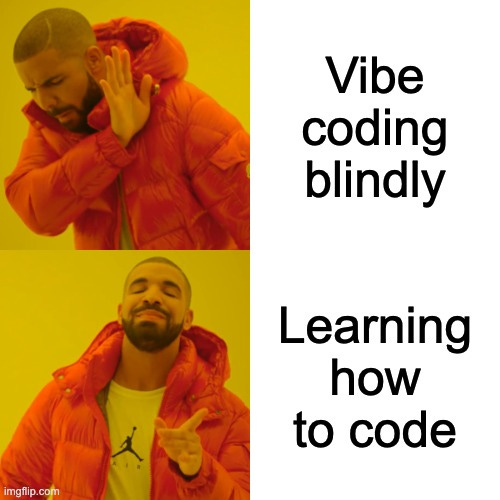
Fixing this is simple however... but it’s something many aren’t willing to do and that is, just bloody learn to code.
You can use your AI to help you... Use CodeAcademy, use YouTube... I’m not saying you need to explicitly memorise every bit of syntax, but you should learn what a good platform architecture looks like, learn what a controller is, learn what a service is.
What Goes Wrong
I’ve seen this so many times now, someone builds something cool in a weekend, gets excited, keeps adding features, and then around week three everything falls apart. They can’t add new things without breaking old things, they can’t find where anything lives. The AI keeps generating code that conflicts with code it generated yesterday.
The core issue is that AI has no persistent memory of your project. Every prompt is a fresh start. It doesn’t know you’ve been using async/await, it doesn’t know your API returns camelCase, it doesn’t know you put auth logic in a separate service. So you get inconsistency stacked on inconsistency until the whole thing becomes unmaintainable.
So my first tip is use this repo I created
https://github.com/andrefigueira/.context/
It’s a way to build documentation for your AI, it works with
and
files, and the idea is you create a well structured easily traversable substrate of information for your AI to quickly find out how your project works and how it should work on it.
Everything Becomes Spaghetti

When you don’t understand code structure, you just accept whatever the AI gives you, the AI doesn’t know your project’s architecture because it doesn’t have one so It generates code that works in isolation, you paste it in, it works... and then you do that 50 more times.
Now you’ve got functions calling functions calling functions, logic scattered everywhere, and no clear path through any of it. Want to change how login works? Good luck figuring out which of your 40 files touches authentication.
Nothing Stays Consistent
One prompt gives you async/await, the next one uses callbacks, another uses .then() promises and your API returns user_name here and userName there. Some files use classes, others don’t.
The AI doesn’t remember what patterns you established three prompts ago and if you don’t understand why consistency matters, you won’t notice until everything is a mess.
The 3000-Line Controller
This is the classic vibe coder signature, one file that does everything. User authentication, payment processing, email sending, database queries, business logic, validation... all in one beautiful unmaintainable blob.
It happens because when you prompt “add password reset functionality” the AI just puts it wherever seems convenient. Without understanding separation of concerns, you don’t know to ask for anything different.
The Debugging Black Hole
Vibe-coded projects work perfectly until they don’t and when something breaks, you’re stuck, you don’t understand what the code does. The AI that wrote it has no memory of the context.
The Stuff You Actually Need to Learn
Look, I’m not saying you need a CS degree... What I am saying is that learning some fundamentals transforms AI from a lottery ticket into something genuinely powerful.
SOLID Principles
These are patterns that emerged from people building real systems and figuring out what doesn’t fall apart.
Single Responsibility means each piece of code does one thing. Your UserController handles user requests. It doesn’t also send emails and process payments. When you understand this, you prompt differently... “Create a separate EmailService class for sending notifications.” The output is immediately better.
Open/Closed means designing code that can grow through addition instead of constantly editing existing stuff. Fewer bugs in existing features when you add new ones.
Dependency Inversion means your high-level code doesn’t depend on low-level details. Both depend on abstractions. This is how you build systems that can actually evolve.
The other two, Liskov Substitution and Interface Segregation, they’re about keeping your contracts clean and your interfaces focused. You’ll internalize these naturally as you build more.
Clean Code
This is really just about readability, variable names that explain themselves, functions that do what their names suggest and code that communicates intent without needing comments everywhere (though comments are nice to have too).
When you understand clean code, you can evaluate what the AI generates. You can ask it to refactor, to use better names, to split functions that are doing too much.
DRY (Don’t Repeat Yourself)
When you see the same logic in three places, that’s a bug waiting to happen. You’ll change it in two places, forget the third, and spend hours debugging something that should have been a non-issue.
Understanding DRY means you spot duplication in AI output and ask it to extract reusable functions.
KISS (Keep It Simple)
The simplest solution that works is usually the best one. AI loves to over-engineer. Ask for login and you might get OAuth, JWT, refresh tokens, session management, the works.
Understanding KISS lets you push back. “I just need basic username/password auth for now, simplify this.”
Design Patterns
Patterns are just proven solutions to problems that keep coming up.
Adapter Pattern wraps third-party APIs so your codebase isn’t coupled to them. When that API changes or you switch providers, you change one file.
Repository Pattern separates data access from business logic. Your application doesn’t need to know if you’re using PostgreSQL or MongoDB.
Factory Pattern creates objects without specifying their exact class. Good for flexibility.
You don’t need to memorise every pattern. Just knowing they exist means you can prompt “implement this using the repository pattern” and actually understand what comes back.
What Changes When You Learn This Stuff
The thing that surprised me... learning to code properly makes AI assistance more valuable, not less.
You become the architect. Instead of accepting whatever the AI generates, you design the structure. You decide where things live. You prompt within that architecture and get consistent, maintainable results.
You can actually debug. When something breaks, you can read the code, understand the flow, ask targeted questions. “This service returns null when it should return an empty array, check the repository layer.”
You review and refine. The AI generates a draft, you evaluate it against your principles, you ask for improvements. The quality multiplies.
You prompt with precision. “Create a UserService class following single responsibility, it should only handle user business logic, inject a UserRepository for data access and an EmailService for notifications.” That produces dramatically better code than “make a user system.”
How to Actually Learn This
Pick one language and learn it properly. JavaScript/TypeScript or Python. Understand it well enough to read code without AI help.
Build something small without AI. A todo app, a simple API. Feel the pain of decisions, understand why structure matters.
Read Clean Code by Robert Martin, at least the first half. Apply it immediately.
Study SOLID through examples, not definitions. Understand the problems each principle solves.
Learn a few common patterns. Repository, Factory, Adapter, Observer. Know when to apply each.
Then go back to AI-assisted development and notice the difference.
Seriously, learn to code!
Vibe coding is a valid starting point, but staying there is a bad idea because it means you’re not really contributing much, those who know how to architect applications move much faster and get much better results than vibe coders. The people shipping real products with AI aren’t just prompting and hoping, they understand software architecture, they design systems, they use AI to execute faster.
Learning to code properly doesn’t make AI less useful, It makes you the one directing a powerful tool instead of being dragged around by it.
Follow me for more on how you can turn your AI coded slop into nicely architected applications that work and are easy to maintain.
You're hooking me, André. And I can see the power of actually understanding a coding language. I just wonder if you have so much tacit knowledge that all this seems so easy for you. It's like the old meme of drawing an owl.