
The War With No Off Switch
A NexusHQ Strategic Intelligence Briefing on Nuclear Escalation Risk in the Israel-Iran Conflict

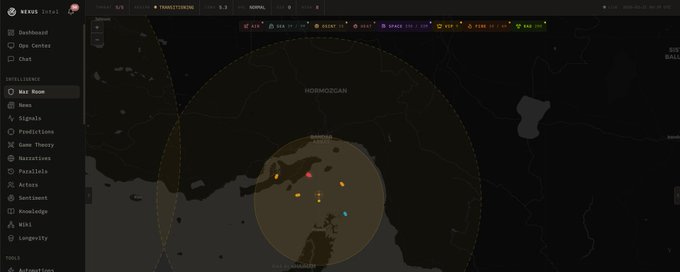
A NexusHQ Strategic Intelligence Briefing on Nuclear Escalation Risk in the Israel-Iran Conflict
Classification: Open Source Intelligence Assessment Date: 21 March 2026 Analyst: André Figueira, NexusHQ Methodology: Bayesian probability fusion, game-theoretic escalation modelling, open-source signal aggregation
Executive Summary
The US-Israeli conventional campaign against Iran is achieving its stated military objectives at a pace that has exceeded most pre-war estimates. However, the structural dynamics of the conflict, specifically the absence of diplomatic offramps, the presence of religious ideologues in the command structures of all three principal actors, and the unresolved status of Iran’s near-weapons-grade uranium stockpile, are converging toward escalation pathways that carry non-trivial nuclear risk.
This briefing assesses those pathways, assigns calibrated probability estimates to key scenarios, and identifies the variables most likely to shift those estimates over the coming months.
1. Situational Context
Three weeks into Operation Epic Fury, the US-Israeli coalition has executed over 7,600 strikes across Iran in nearly 5,000 aerial sorties. The following capabilities have been degraded or destroyed:
Missile infrastructure: More than 70% of Iran’s missile launchers neutralised (IDF, 16 March 2026)
Air defence: Over 85% of detection and defence systems, including radars and air defence platforms, neutralised (IDF, 16 March 2026)
Naval capability: Over 100 Iranian naval vessels destroyed (CENTCOM Admiral Brad Cooper, 16 March 2026)
Command and control: Supreme Leader Ali Khamenei assassinated 28 February. Iran’s Foreign Ministry acknowledged that military units are operating on standing orders due to chain-of-command degradation
Air dominance: The US is flying non-stealth B-1 bombers through Iranian airspace, indicating near-total confidence in air superiority (Al Jazeera, 16 March 2026)
IDF Spokesman Brig. Gen. Effie Defrin has stated publicly that the military has plans for at least three more weeks of operations with “thousands of targets ahead,” with deeper planning extending beyond that window.
By conventional military metrics, this campaign is succeeding. The critical question is not whether it can achieve its tactical objectives, but whether it can stop.
2. The Structural Inability to De-escalate
Every prior escalation threshold in this conflict sequence has been exceeded. The Gaza operation expanded beyond its initial scope. The Lebanon intervention was not contained. The June 2025 twelve-day strikes were presented as sufficient but were followed by renewed operations nine months later.
Three structural factors inhibit de-escalation:
2.1 Israeli domestic politics
Prime Minister Netanyahu faces criminal prosecution, an October 7 commission of inquiry, and coalition fragility the moment hostilities cease. The war serves as the primary mechanism for maintaining political survival. More significantly, the war is being framed in explicitly religious terms. At a press conference on 13 March 2026, Netanyahu stated that Israel would “achieve the kingdom” and await “the Messiah’s return,” adding that this would not happen “next Thursday,” implying the war must continue until conditions for messianic fulfilment are met.
National Security Minister Itamar Ben Gvir has called for the collapse of Iran’s regime to be declared a stated war goal. Finance Minister Bezalel Smotrich has stated Iran is “starting from zero.” Both have consistently invoked biblical justifications for territorial expansion. US Ambassador to Israel Mike Huckabee, an evangelical pastor, stated publicly that it would be “fine if Israel took” all of the land of the Middle East.
2.2 US command structure
US Defense Secretary Pete Hegseth, author of “American Crusade” (2020), has introduced explicitly Christian nationalist rhetoric into the Pentagon’s operational framework. He hosts monthly Christian worship services for Pentagon employees, has displayed Bible verses in departmental promotional videos alongside military footage, and recited Psalm 144 (”Blessed be the Lord, my rock, who trains my hands for war and my fingers for battle”) at a Pentagon press briefing during the conflict.
Hegseth has crusader imagery tattooed on his body, including the Jerusalem Cross and the phrase “Deus Vult” (”God wills it”), which he has described as “the rallying cry of Christian knights as they marched to Jerusalem.”
Following the outbreak of hostilities, claims circulated that US military commanders were telling troops the war fulfilled biblical prophecies around Armageddon and the return of Christ. Thirty Democratic members of Congress requested a Pentagon inspector general investigation. The AP has not independently verified the claims, but three major watchdog organisations, the Freedom From Religion Foundation, the Anti-Defamation League, and the Council on American-Islamic Relations, have raised concerns.
Georgetown visiting scholar Matthew D. Taylor, a specialist in religious extremism, stated: “The U.S. voluntarily going to war against a Muslim country with the military under the leadership of Pete Hegseth is exactly the kind of scenario that people like me were warning about.”
2.3 Absence of institutional guardrails
Congress has not formally authorised the use of military force. Career diplomatic and intelligence professionals have been systematically marginalised across both the US and Israeli national security establishments over the preceding years. The institutional mechanisms that would ordinarily constrain escalation, legislative oversight, independent intelligence assessment, diplomatic back-channels, are either absent or degraded.
3. The Uranium Variable
An estimated 440 kilograms of uranium enriched to 60% purity, near weapons-grade, remains unaccounted for in tunnels at Isfahan. The IAEA has no access to verify its status. This material, if further enriched to 90%, would be sufficient for as many as 10 nuclear weapons.
Ali Vaez, Director of the Iran Project at the International Crisis Group and trained nuclear physicist, confirmed in a 20 March 2026 NPR interview that the two critical ingredients for an Iranian weapon, advanced centrifuges and enriched material, survived the June 2025 twelve-day war. Pre-war assessments estimated six months to one year to convert enriched material into a deliverable weapon. Current infrastructure degradation likely extends that timeline, but the knowledge base, the scientific workforce, and potentially the material itself remain intact.
Western intelligence assessments of Iranian nuclear capability have a poor track record. The Fordow enrichment facility was unknown to Western intelligence until Iran disclosed it. The full scope of the Amad weaponisation programme was not understood until the 2018 Mossad archive seizure. Advanced centrifuges stored in hidden facilities survived the June 2025 strikes despite being assessed as destroyed. Iran built its entire nuclear programme under 45 years of international sanctions.
The pattern is consistent: every time capability is destroyed, Iran reconstitutes it at greater depth, with more dispersal and hardening. The assumption that infrastructure destruction equates to permanent capability denial is not supported by the historical evidence.
The A.Q. Khan proliferation network demonstrated that nuclear technology transfers occur through covert channels. Both Pakistan and North Korea possess strategic incentives to assist an Iranian weapons programme, though no evidence of active transfers during the current conflict has been reported in open sources.
4. Escalation Pathway Analysis
4.1 The paradox of success
The conventional campaign’s success is itself an escalation driver. Military success breeds objective expansion, objective expansion removes offramps, and the absence of offramps in a conflict involving a nuclear-capable state with religious ideologues in the command structure creates conditions for catastrophic miscalculation.
Each additional week of operations increases the probability of crossing a civilisational tripwire: a strike on Al-Aqsa Mosque (Ben Gvir has already pushed Temple Mount provocations in peacetime), a single-event mass casualty incident among Iranian civilians, strikes on the holy cities of Qom or Mashhad, or a ground incursion.
4.2 Iran’s shifting calculus
Iran is currently absorbing punishment and rationing its remaining missile capability. Absorption, however, has a structural limit. The regime faces a binary choice as the war continues: accept destruction or escalate beyond conventional means.
A regime led by a new Supreme Leader (Mojtaba Khamenei, elected 8 March 2026) with limited legitimacy, surrounded by an ideological apparatus that incorporates martyrdom as operational doctrine, does not process cost-benefit analysis in the manner Western deterrence theory assumes. The war has made the strategic case for an Iranian nuclear deterrent stronger than at any point in the programme’s history. Every future Iranian government, regardless of political orientation, will have nuclear acquisition near the top of its strategic agenda.
4.3 The missing deterrence architecture
The historical precedent most commonly invoked is Cold War deterrence. The analogy fails on every structural dimension:
No communication channel. There is no hotline between Jerusalem and Tehran, no back-channel, no diplomatic intermediary with access to both decision-making apparatus simultaneously.
No treaty framework. No arms control agreements, no mutual inspections regime, no shared understanding of red lines.
No secular rationality assumption. Both sides have leaders who publicly invoke divine mandate for their military operations. The rationality assumption underpinning deterrence theory does not hold when decision-makers believe transcendent forces are directing the conflict.
No institutional depth. The career professionals who managed Cold War crises, the Kennans, the Dobrynins, the back-channel operators, have no equivalents in this conflict.
If Iran achieves nuclear capability, the result is two nuclear-armed states with zero diplomatic infrastructure, no arms control framework, separated by 1,000 miles of airspace they have both used in active combat operations, governed by leaders on both sides who frame the conflict in eschatological terms. This is not deterrence. This is improvisation at civilisational stakes.
5. Probability Assessment
The following estimates represent calibrated assessments based on Bayesian probability fusion across the identified variables. All probabilities are assessed over a 12-month horizon from the date of publication.
Scenario Probability Key Variables Iran achieves covert nuclear breakout (device assembled, not necessarily tested) 12-20% Survival of Isfahan material, external assistance, covert reconstitution of enrichment capability Israel conducts preemptive nuclear strike on suspected Iranian nuclear facility 3-7% Conditional on Israeli intelligence concluding Iranian breakout is imminent, conventional strikes assessed as insufficient Iran delivers nuclear weapon against Israeli target 2-5% Conditional on successful covert breakout, delivery system availability, regime decision calculus Full nuclear exchange (both parties) 1-3% Conditional on first use by either party, second-strike doctrine activation Conflict triggers civilisational flashpoint (Al-Aqsa, holy city strike, mass casualty threshold) that fundamentally restructures the conflict 15-25% Duration of operations, composition of Israeli war cabinet, degradation of target discrimination over time Conflict concludes through negotiated settlement within 12 months 10-20% Requires change in US or Israeli political leadership, or Iranian regime collapse/capitulation
Note on calibration: A 1-3% probability of nuclear exchange, assessed over 12 months and compounded over a decade of structural hostility without diplomatic architecture, produces cumulative odds that no rational strategic framework should accept as tolerable. The purpose of quantifying low-probability, high-consequence scenarios is not to predict them but to make visible the risk that qualitative analysis tends to suppress.
6. Key Indicators to Monitor
The following signals would materially shift the probability assessments above:
Escalatory indicators:
Any Israeli military activity near Al-Aqsa Mosque or the Temple Mount
Strikes on Qom, Mashhad, or other sites of religious significance
Reports of Iranian enrichment activity at undisclosed locations
Changes to Israeli nuclear force posture (submarine deployment patterns, Jericho missile activity)
Ground force deployment to Iranian territory
Israeli interceptor stockpile depletion reports
North Korean or Pakistani diplomatic signals regarding Iran
De-escalatory indicators:
Resumption of Omani-mediated or other back-channel negotiations
Congressional authorisation debate (indicates institutional engagement)
IAEA access to Isfahan
Israeli domestic political shift (coalition fracture, election announcement)
Public fracture between US and Israeli war aims (the South Pars incident on 19 March is a potential early signal)
Iranian formal ceasefire proposal with verifiable conditions
7. Assessment
The conventional war is succeeding on its own terms. That is precisely the problem. Success breeds expansion, expansion removes offramps, and the absence of offramps in a conflict between nuclear-capable states with religious ideologues embedded in the command structure is the structural precondition for outcomes that nobody plans and nobody can reverse.
The question is not whether any actor wants nuclear war. The question is whether the structure of this conflict, the incentives, the actors, the absent guardrails, is converging toward it regardless of intention.
The assessed trajectory suggests it is, at a pace that exceeds what most public commentary acknowledges.
NexusHQ provides calibrated geopolitical and market intelligence. All probability assessments are subject to revision as new information becomes available. Methodology documentation, including Brier Score tracking and calibration metrics, is available at nexushq.xyz.
Sources: CENTCOM operational briefings, IDF Spokesperson statements, International Crisis Group, Arms Control Association, IAEA reporting, Atlantic Council, ACLED conflict data, Associated Press, NPR, Al Jazeera, Middle East Eye, Scientific American, House of Commons Library, Britannica, PBS, CNN, Times of Israel, Military Times, Stars and Stripes, Janes Defence.
Fascinating and somewhat chilling analysis, especially with the inclusion of the religious ideological aspects, which are usually brushed over or not mentioned at all in typical news media reporting.