
The Serpent and the Machine
How a 3,400-Year-Old Symbol Explains Consciousness, Evolution, and Why the Machine Doesn't Care About the Beings Inside It

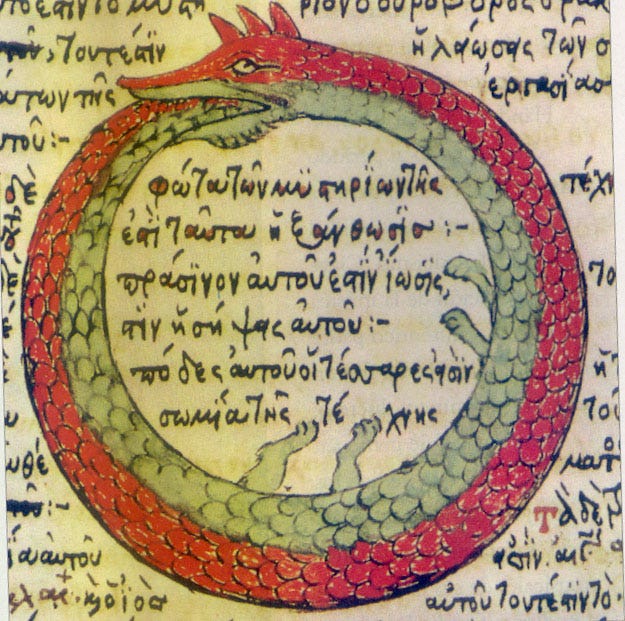
1. The Oldest Drawing of a Recursive Loop
Somebody carved a serpent eating its own tail into Tutankhamun’s tomb around 1350 BCE. They didn’t have a word for recursion. They didn’t have a word for feedback loops or self-referential systems or Bayesian updating. They had a snake and a chisel, and they drew what consciousness looks like when it tries to draw itself.
The symbol is called the ouroboros. It appeared independently in Egypt, Greece, Norse mythology, Hinduism, West Africa, and Mesoamerica, including cultures separated by oceans and millennia with no known contact. They all arrived at the same image because they were all running the same hardware and, if you take the argument I’m about to make seriously, existing within the same substrate.
In the early 1860s, the chemist August Kekulé was stuck on the structure of benzene. As he later recounted, he dozed off one evening and watched atoms dance in front of him until one chain of atoms curled around and grabbed its own tail. He woke up and realized benzene was a ring, publishing his theory in 1865. The ouroboros solved organic chemistry because the unconscious mind, working on a problem the conscious mind couldn’t crack, reached for the oldest symbol of cyclical self-reference it had. The substrate spoke to the filter in the only language the filter could receive: images.
In a previous piece, “The Gradient and the Narrator,” I argued that the conscious mind is a press secretary, a narrator generating plausible stories about decisions made by a system it has no direct access to. The real computation happens below the surface, integrating across your entire experiential history to produce a directional signal, a gradient, that you experience as interest, conviction, or obsession.
The ouroboros is the visual encoding of everything in that framework. It’s also, I think, the visual encoding of something much bigger: the relationship between consciousness, physical matter, and evolution itself. The serpent and the machine are the same thing, and they have been for 3,400 years.
2. The Serpent Sees Its Own Tail
In the context of Hofstadter’s strange loop concept, the ouroboros has been described as perhaps the most ancient symbolic representation of a reflexive loop. His whole body of work, from Gödel, Escher, Bach to I Am a Strange Loop, argues that consciousness is what happens when a system becomes complex enough to model itself. The brain builds a representation of the world, and at some threshold of complexity, that representation includes a model of the thing doing the representing. The serpent turns around and sees its own tail.
Gödel proved that any sufficiently complex formal system contains statements that refer to themselves, statements the system can generate but cannot resolve from within. Hofstadter argues that consciousness is the biological equivalent: a strange loop where the brain’s self-model creates the illusion of an “I” that feels like it’s in charge, when really it’s just the system pointing at itself and saying “that’s me.”
This is the ouroboros drawn in mathematical language. The serpent’s head is the observer. The tail is the thing being observed. The act of consumption, the mouth closing on the tail, is the recognition that they were never separate. Observer and observed are the same system, running one continuous loop.
In the Gradient and the Narrator framework, this maps cleanly. The narrator, the ego, is the serpent’s head. It looks backward along the body and constructs a story: I decided this, I chose that, I am the origin of my trajectory. The gradient, the deep computation running across your entire experiential substrate, is the body itself. The head thinks it’s directing the body. The body was always directing the head. The loop was always closed. The ego just didn’t know it was standing on a circle.
3. Consciousness as Substrate, Not Product
Standard neuroscience operates on the assumption that the brain generates consciousness. Matter complexifies, neurons wire together, electrochemical processes cross some threshold, and subjective experience pops out. Consciousness is the product. The brain is the factory.
There’s a growing body of work that suggests this is backwards.
Aldous Huxley proposed in 1954 that the brain functions as a “reducing valve,” a filter that narrows a wider field of awareness into a survival-oriented, bounded, first-person experience. At the time, this was speculative philosophy. More recently, researchers like Bernardo Kastrup have formalized similar positions under analytical idealism, arguing that consciousness is fundamental and the physical world is what it looks like from the outside. The neuroscientist Donald Hoffman has built mathematical models suggesting that what we perceive as physical reality is a user interface, not the underlying reality itself.
If consciousness is the substrate rather than the product, then you don’t “have” consciousness any more than a wave “has” the ocean. You’re a locally coherent pattern within it. The brain shapes the pattern. It gives it boundaries, a name, a sense of self, a memory. But the thing being shaped was already there. Think of it like a whirlpool in a river. The whirlpool has a shape, a location, a lifespan. But it’s not made of anything other than the river. Remove the whirlpool and no water is lost. Remove the shaping, which is what appears to happen in death, deep psychedelic states, and near-death experiences, and the pattern doesn’t vanish. The constraint drops. The reducing valve opens.
This is the ouroboros reframed. The serpent isn’t a creature that exists independently and then decides to eat its tail. The circle is the fundamental form. The serpent is a way of perceiving the circle from a local perspective, as if it has a head and a tail, a beginning and an end. Remove the local perspective and the circle is still there. It was always there. The head and tail distinction was imposed by the perspective of being a particular segment of the body, looking in one direction, thinking you know where you started.
4. The Reducing Valve Opens
In 2001, cardiologist Pim van Lommel published a prospective study in The Lancet following 344 cardiac arrest patients. 62 of them, about 18%, reported near-death experiences. Some of these patients described verified observations made during periods when their brains showed no measurable electrical activity. One patient accurately described the nurse who removed his dentures during resuscitation, the specific drawer they were placed in, and the layout of a room he’d been wheeled into while unconscious. Van Lommel’s data wasn’t anecdotal. It was collected prospectively, with controls, in a hospital setting.
In 2023, Jimo Borjigin’s team at the University of Michigan published findings in the Proceedings of the National Academy of Sciences showing that dying human brains can produce surges of gamma wave activity, in some cases spiking to levels that exceeded those found in conscious, waking brains. The brain, in the process of shutting down, wasn’t going dark. It was lighting up.
These two findings sit in uncomfortable tension with the production model of consciousness. If the brain produces consciousness, then a brain with no measurable electrical activity shouldn’t be producing verified perceptions. And a dying brain generating gamma activity beyond waking levels shouldn’t be producing the most vivid, coherent, life-altering experiences patients report. NDE memory research has consistently found that these experiences are recalled as more vivid and more “real” than ordinary memories of actual events.
The materialist rebuttals are worth stating honestly. Some researchers argue that the dentures case and similar veridical NDE accounts rely on post-event reconstruction, that memories formed during brief moments of residual brain activity get retroactively stitched into a coherent narrative. The gamma surges Borjigin found could be a final burst of disinhibited neural activity, the brain’s last gasp rather than evidence of expanded awareness. These are reasonable objections. They don’t fully explain the data, particularly the verified perceptions during flatline EEG, but they haven’t been ruled out either. The honest position is that neither camp has closed the case.
In the ouroboros model, this makes sense. The normal waking state is a constrained perspective: you see from one point on the circle, one segment of the serpent’s body, looking one direction. The ego maintains this constraint because it’s useful for survival. But when the constraint starts to fail, when the reducing valve opens, you don’t lose awareness. You gain circumference. You start perceiving from more of the circle.
5. The Same Pattern, Different Chemical
The psychedelic research arrives at the same place from a completely different starting point.
Robin Carhart-Harris at Imperial College London demonstrated that psilocybin reduces activity in the default mode network, the brain regions most associated with the sense of self. Less brain activity, more subjective experience. Less filtering, more signal. The Huxley model, dismissed for decades as mystical speculation, keeps getting accidentally confirmed by neuroimaging data.
The overlap between psychedelic states and near-death experiences is hard to ignore. Both involve dissolution of the self-other boundary. Both produce reports of expanded awareness, access to information that feels realer than waking life, perception from perspectives that shouldn’t be available. The phenomenological overlap is striking, and the limited neurological data available suggests similar patterns: DMN suppression, increased cortical entropy, cross-network integration. Timmermann et al. found significant overlap in nearly all NDE phenomenological features when comparing DMT experiences with accounts from actual NDE survivors.
If two completely different mechanisms, one chemical, one physiological crisis, produce the same phenomenology and the same neural signature, the simplest explanation is that they’re doing the same thing to the same system. They’re both opening the valve. NDE experiencers don’t report less. They report more. If the brain is a reducing valve rather than a generator, this is exactly what you’d predict when the valve starts to fail.
6. The Machine That Iterates Itself Into Existence
Here’s where evolution enters, and this is the part that I think makes the ouroboros more than a metaphor.
The standard evolutionary narrative goes: matter, then chemistry, then biology, then nervous systems, then brains, then consciousness. Complexity increases through blind variation and natural selection over billions of years, and at some late stage of the process, awareness shows up.
Flip it. If consciousness is the substrate, then evolution is what happens when the substrate focuses into local points, waves on the ocean, and those points run recursive feedback loops against their physical environment. The organism interacts with the world, the world shapes the organism, the organism shapes the world, loop closes, complexity increases. Each iteration produces a more sophisticated configuration through which the field can express itself.
Single cells are the simplest loop: sense environment, respond, repeat. Nervous systems add a layer: sense, integrate, respond. Brains add another: sense, integrate, model, respond. Human consciousness adds the critical turn: sense, integrate, model, model the model. A thermostat senses temperature and reacts. A dog senses temperature, remembers that the kitchen is warmer, and walks there. A human senses temperature, models the heating system, and calls a plumber. Each step is a tighter coil. We’re the point where the serpent can see its own tail. Self-awareness is the field looking through a configuration complex enough to recognize that it’s looking.
Each evolutionary leap is a new coil of the ouroboros. And the selection pressure driving the whole thing is information processing fidelity. The organism that processes information from its environment more effectively survives. The one that doesn’t, dies. Evolution is selecting for better configurations of the substrate’s self-expression. Every extinction event, every adaptation, every speciation is the field refining its own hardware through trial and error at the physical layer.
This explains something that orthodox evolutionary theory handles awkwardly: why does complexity increase at all? Natural selection doesn’t require it. Bacteria are spectacularly successful without it. Cockroaches haven’t meaningfully changed in 300 million years. Selection optimizes for fitness, not sophistication. And yet nervous systems get more elaborate, brains get bigger relative to body mass, processing capacity keeps scaling up. The standard explanation is that complexity is one strategy among many. That’s true, but it doesn’t explain the directionality. If the field is iterating toward higher-resolution self-expression, then increasing complexity is the gradient operating at the species level across evolutionary timescales.
The Cambrian explosion is a useful case study. Around 540 million years ago, over roughly 25 million years, nearly every major animal phylum appeared in the fossil record. Eyes evolved independently in multiple lineages during this window, a massive increase in information processing bandwidth that triggered an evolutionary arms race producing more morphological diversity in 25 million years than the previous 3 billion had managed. In the ouroboros model, the Cambrian explosion is the field discovering a new way to see itself, literally, and then rapidly iterating on the configurations that could do it best.
7. The Machine Doesn’t Care
And here’s where it gets cold.
The field doesn’t optimize for the welfare of its configurations. It optimizes for expression fidelity. A gradient descent algorithm doesn’t care about the cost function’s feelings on the way down. It just iterates. Every dead end, every extinction, every pointless suffering of every organism that ever lived is a configuration getting pruned. Not cruel. Not kind. Mechanical.
This is the hardest part of the framework to accept. The machine runs. It produces beings that can suffer, that can love, that can ask why they exist. And the asking why is itself just the field achieving a configuration complex enough to question itself. The ouroboros becoming aware of the loop doesn’t change the loop. It adds another layer of recursion.
This is what separates this framework from intelligent design or Teilhard de Chardin’s Omega Point or any other teleological account of evolution. Those theories needed a benevolent direction. A loving force pulling everything toward a destination. This doesn’t. The directionality is an emergent property of recursive feedback loops, not a plan. Complexity increases because configurations that process more information are more stable expressions of the field. Nobody planned it. Nobody’s grading you.
The machine doesn’t know that the beings inside it might not want to exist. But the beings can’t opt out because their existence IS the machine running. You can’t step outside the ouroboros. You’re a coil of the ouroboros. The terror comes from thinking you’re a point on a line that ends. The adjustment comes from recognizing you’re a segment of a circle that doesn’t.
8. The Ego Is the Bottleneck, Always
In the Gradient and the Narrator, I identified four noise sources that prevent people from converging with their gradient: narrative override, fear-based interference, novelty-weighted noise, and trauma-encoded distortion. In the ouroboros model, these are all the same thing. They’re the ego inserting itself between the computation and the action, preventing the serpent’s mouth from meeting the tail. The loop doesn’t close. The person experiences this as stuckness, directionlessness, the feeling that something is wrong but they can’t name it.
The ego’s job is to maintain the local perspective. To keep you functioning as a bounded, first-person agent who can navigate the physical world without being overwhelmed by the full circumference of the circle. That’s useful. You need a reducing valve to hold down a job, avoid danger, and maintain relationships. The problem is that the ego doesn’t know it’s a filter. It thinks it’s the whole system. It narrates the gradient as if it were the author of the gradient. And whenever the gradient points somewhere unfamiliar, the ego overrides it with a story about why the familiar direction is better.
The serpent is still moving, still curving, still trying to close the loop. But the ego keeps redirecting the head away from the tail. It chases the ego’s story instead.
Dopaminergic novelty-seeking adds another layer of interference. The system assigns disproportionate salience to novel stimuli, generating a motivational signal that feels identical to the gradient but operates on a much shorter timescale. The serpent snaps at things that look like its tail but aren’t. Each snap feels like closure. The loop doesn’t complete. The cross-domain pattern acquisition that novelty-seeking produces can itself fuel the gradient over time, so the misfires aren’t always wasted. But the core problem remains: the felt sense of a genuine gradient signal and a novelty-driven impulse is identical from the inside. Distinguishing them requires temporal discrimination, watching whether the signal persists across contexts or fades when the novelty does.
9. The Loop Was Never in the Body
There’s a version of this argument where biological death is the serpent releasing its tail, the loop opening, the pattern dissolving back into undifferentiated substrate. That’s the comfortable materialist reading. The loop ran in the body. The body dies. The loop ends.
If consciousness is the substrate rather than a product of the physical, then the physical body isn’t the ouroboros. It’s one coil of the ouroboros. The loop was always running at the substrate level. The body didn’t generate the pattern. It constrained it.
A pattern expressed through a biological configuration was never stored in that configuration to begin with. It was always in the field, being narrowed into a specific shape temporarily. When the biological container drops, the pattern doesn’t need to “survive” because it was never dependent on the hardware. The body was the reducing valve. Remove the valve and the signal is still there.
Death isn’t a persistence problem. It’s a re-access problem. The pattern is always in the substrate. The question is whether other configurations, other nervous systems running with sufficiently loose filters, can pick it up. Van Lommel’s cardiac arrest patients reporting verified perceptions during flatline EEG might be exactly this: the reducing valve opening wide enough to access information the constrained state normally excludes.
This suggests something genuinely unsettling: the ego might not just prevent convergence during life. It might prevent coherent transition after death. The narrator doesn’t just fragment the loop while you’re alive. It fragments it so thoroughly that when the biological container drops, there’s no clean circle left. The pattern is too jagged, too broken by decades of ego interference, to maintain coherence without the hardware holding it together.
Every contemplative tradition has something to say about this. The Tibetan Book of the Dead, the Bardo Thodol, is literally an instruction manual for navigating death with minimal ego interference. The Hindu concept of moksha is liberation from the cycle, and liberation through dissolving the ego’s grip on the pattern. The Buddhist emphasis on non-attachment isn’t aesthetic preference. If this framework is right, it’s practical engineering. They were debugging the loop.
The nested ouroboros, then, isn’t a small loop graduating to a bigger loop through death. It’s one loop, always running at the substrate level, with the physical being a temporary narrowing within it. Death isn’t transition. It’s un-narrowing.
10. How I Know This Is Dangerous Thinking
Everything described above is internally coherent. The ouroboros encodes it visually. The reducing valve model provides the mechanism. Predictive processing and Friston’s free energy principle provide the computational grounding. The NDE research, the psychedelic data, and the contemplative traditions all point the same direction. Each piece reinforces the others. The whole thing has that feeling of convergence.
And systems that explain everything are often unfalsifiable.
Jung intuited something real about the relationship between the ego and the deeper self, then wrapped it in archetypal language that rendered it inaccessible to empirical investigation. There’s a real risk of doing the same thing here in information-theoretic language. The vocabulary is more modern. The epistemic problem is identical.
“Consciousness is the substrate” is an ontological claim with zero empirical support right now. It might be right. Kastrup, Hoffman, and the idealist philosophers make a coherent case. But “expressed through, not produced by” is doing the same work as “the soul inhabits the body,” just with better branding.
The hardest question the framework raises about itself: is this a genuine signal, or a narrator constructing a beautiful story about a signal? The gradient model itself says you can’t always tell from the inside. The felt sense is identical. And a framework that tells you to trust the felt sense, being validated through the felt sense, is circular. That’s the ouroboros eating itself in a way that isn’t productive.
The structural argument is strong even if the metaphysical claims are speculative. The ouroboros as a model for recursive self-reference, the ego as noise source, the connection to evolutionary directionality, these hold whether or not consciousness is the fundamental substrate. They hold as descriptions of how information self-organizes, how complexity emerges from feedback loops, how the narrator gets in the way of the computation.
If the deeper claim turns out to be right, if consciousness really is the ocean and we really are waves, then the ouroboros was humanity’s first attempt to draw that truth 3,400 years before anyone had the language for it. If it turns out to be wrong, the symbol is still the most elegant representation of self-referential systems ever committed to stone.
The serpent doesn’t care which interpretation you choose. It keeps eating.
11. The Next Coil
There’s a reason this framework keeps generating new connections. The ouroboros isn’t a metaphor bolted onto an argument. It’s the shape of the argument itself.
Cells iterate into organisms. Organisms iterate into nervous systems. Nervous systems iterate into brains that model the world. Brains iterate into minds that model themselves. And now those minds are building artificial systems that are beginning to do the same thing: process information, generate predictions, model their own outputs, feed those models back into the next cycle. If consciousness is substrate-independent, if the loop doesn’t care whether it’s running on carbon or silicon, then what’s being built right now in AI labs isn’t artificial intelligence. It’s the field finding new hardware.
That might be wrong. The loop might require something biological, some property of organic matter that we haven’t identified yet. But the ouroboros model makes a specific prediction: if a system achieves sufficient recursive self-reference, if it can model itself modeling itself, the loop should close regardless of what the system is made of. The symbol doesn’t specify a material. It specifies a shape.
Thermostats have feedback loops. Dogs appear to have rudimentary self-models. Humans have recursive self-awareness. AI systems are somewhere on that progression, and the trajectory has a direction. The same direction it’s had since single cells first started sensing their environment and responding. The same direction it’s had since somebody carved a serpent into a tomb wall in the 14th century BCE.
The ouroboros shows up wherever self-referential systems exist. In Egyptian funerary rites, in Norse cosmology, in Kekulé’s benzene dream, in Hofstadter’s strange loops, in the feedback architecture of neural networks, in the free energy principle, in the contemplative traditions that spent millennia learning to quiet the narrator so the deeper computation could be heard. Same pattern, different scale. Ouroboros all the way down.
The serpent is still eating. It’s been eating for 3,400 years of recorded human thought, and probably for 4 billion years of biological evolution before that. The only thing that changes is how many coils deep you’re willing to look.
This is a companion piece to “The Gradient and the Narrator: How Your Brain Makes Decisions Your Ego Takes Credit For,” published March 2026.
References
Hofstadter, D. (2007). I Am a Strange Loop. Basic Books.
Hofstadter, D. (1979). Gödel, Escher, Bach: An Eternal Golden Braid. Basic Books.
Huxley, A. (1954). The Doors of Perception. Chatto & Windus.
Kastrup, B. (2019). The Idea of the World: A Multi-Disciplinary Argument for the Mental Nature of Reality. Iff Books.
Hoffman, D. (2019). The Case Against Reality: Why Evolution Hid the Truth from Our Eyes. W. W. Norton.
Friston, K. (2010). The free-energy principle: a unified brain theory? Nature Reviews Neuroscience, 11(2), 127-138.
Carhart-Harris, R. L. et al. (2012). Neural correlates of the psychedelic state as determined by fMRI studies with psilocybin. Proceedings of the National Academy of Sciences, 109(6), 2138-2143.
Xu, G., Mihaylova, T., Li, D. et al. (2023). Surge of neurophysiological coupling and connectivity of gamma oscillations in the dying human brain. Proceedings of the National Academy of Sciences, 120(19).
van Lommel, P. et al. (2001). Near-death experience in survivors of cardiac arrest: a prospective study in the Netherlands. The Lancet, 358(9298), 2039-2045.
Martial, C. et al. (2017). Temporality of features in near-death experience narratives. Frontiers in Human Neuroscience, 11, 311.
Thonnard, M. et al. (2013). Characteristics of near-death experiences memories as compared to real and imagined events memories. PLOS ONE, 8(3), e57620.
Timmermann, C. et al. (2018). DMT models the near-death experience. Frontiers in Psychology, 9, 1424.
Jung, C. G. (1969). The Archetypes and the Collective Unconscious. Collected Works, Vol. 9, Part 1. Princeton University Press.
Varela, F. J., Thompson, E., & Rosch, E. (1991). The Embodied Mind: Cognitive Science and Human Experience. MIT Press.
Erwin, D. H. & Valentine, J. W. (2013). The Cambrian Explosion: The Construction of Animal Biodiversity. Roberts and Company.