Brainmaxxing protocols
You have a simulator in your head and you're not using it.
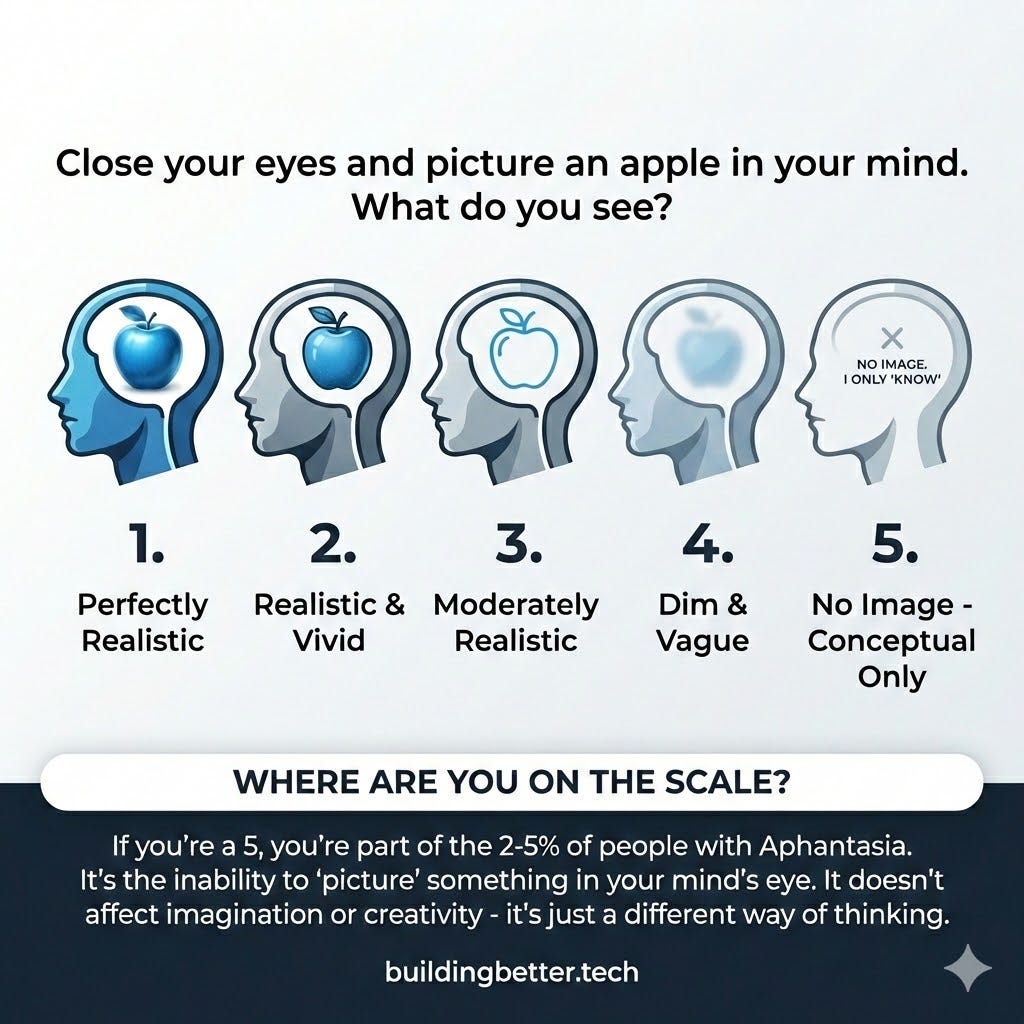
If you’re #5. then I’m afraid this methodology won’t work for you, but if you’re between 1-4 on the scale above you could absolutely benefit from using this technique!
Most people don’t know they have a simulator in their head, not a metaphor, an actual capacity to build, hold, and manipulate complex structures in your mind’s eye, to run scenarios, to stress-test ideas before they touch reality.
The brain can do this, most people just never learn how…
I’ve been using this capacity deliberately for as long as I can remember, although only in recent years really formalised what I had intuited into. When I’m working on a codebase, I don’t just read the code and infer execution like anyone else would, I visualise the actual structure of the application in a multidimensional way, almost like having an IDE in my head. I can hold the architecture, zoom into specific areas, see how changes propagate. It’s not magic, it’s practice, and it’s something you can train if you’re willing to put in the work.
The Spectrum You Didn’t Know You Were On
There’s a condition called aphantasia where people have no visual imagery at all, they can’t picture an apple, can’t visualise their mother’s face, nothing… About 1-4% of the population has this. On the other end, there’s hyperphantasia, where mental imagery is so vivid it’s nearly indistinguishable from perception, roughly 3-5% of people experience this at the extreme end.
Most people sit somewhere in the middle, able to visualise but never really thinking about what that means or how to use it. They’ll “picture” something when asked, but they’ve never treated visualisation as a tool to be sharpened, it’s like having a muscle you occasionally flex but never train.
The research on this is clear, mental imagery ability isn’t fixed. Studies on athletes show that imagery training improves actual physical performance, motor imagery activates similar neural pathways to real movement, and people can dramatically improve their visualisation capacity with deliberate practice. Memory athletes, the people who memorise decks of cards and thousands of digits, aren’t born with superior brains, nine out of ten of them use the method of loci, a spatial visualisation technique, and they built that skill through training.
The method of loci works by encoding information spatially, you imagine walking through a familiar place and associating what you want to remember with specific locations. What I’m describing is a variation on the same principle, but instead of using spatial encoding for memory, you’re using it for reasoning. You build the system in your mind so you can manipulate it, test it, understand it. Same underlying mechanism, different application.
So the capacity is real and it’s trainable, the question is what you do with it.
What Mental Simulation Actually Is
Think of it like foveated rendering, the technique VR headsets use to save processing power. The area you’re looking at gets rendered in high resolution, everything in the periphery stays low-res, but the whole scene persists. Your brain can work the same way.
When I’m holding a complex system in my head, I’m not trying to see every detail at once, I have a coarse global structure, the shape of the thing, the major components and how they connect. Then I focus attention on specific areas and those resolve into higher detail. The rest stays fuzzy but present, and I can pan around, zoom in, zoom out, while the structure maintains itself.
This isn’t photographic memory, it’s more like having a mental model you can walk around in. When you understand something well enough, you don’t need to remember every fact about it, you can reconstruct details from the structure because you understand how the pieces relate.
The neuroscience backs this up. The hippocampus, the brain region involved in spatial navigation and memory, lights up when people use spatial mnemonics. Place cells and grid cells, the neurons that help you know where you are in physical space, appear to get recruited for abstract thinking when you give them something spatial to work with. The brain is built to navigate environments and remember locations, and when you encode information spatially, you’re working with the hardware instead of against it.
Why doesn’t everyone do this?!
Modern development culture has trained people into just-in-time thinking. You don’t need to hold the system in your head if you can grep the codebase, you don’t need to understand the architecture if you can ask the AI, you don’t need to think through the problem if you can throw code at it and see what errors come back.
I see this constantly, developers working reactively, poking at code, checking what happens, Googling the error, pasting the fix. No model of what’s actually going on. They’re running on pattern matching and autocomplete, not comprehension, and it works, kind of, until it doesn’t, until the problem requires actual understanding and they’ve got nothing to fall back on.
The same thing happens outside of coding. People offload everything to external tools, phones remember numbers, search engines remember facts, GPS remembers routes. This isn’t inherently bad, external tools are useful, but there’s a cost. The cognitive capacities you don’t use atrophy, if you never practice holding complex information in working memory, your working memory doesn’t develop, if you never deliberately visualise, your visualisation capacity stays weak.
The method of loci has been around for 2,500 years. The ancient Greeks used it because they didn’t have notebooks, medieval scholars used it because books were rare, memory athletes use it today because it works better than anything else. And almost nobody in the general population even knows what it is, let alone practices it.
The Practice
This isn’t complicated, it’s just effortful. You sit somewhere quiet, eyes open or closed, whatever works for you, and you deliberately visualise a system. You hold it in your mind, you move through it, you try to see it clearly. Then you let your mind wander, take a break, and bring the focus back. You do this repeatedly.
Start absurdly simple. Visualise an apple. Not the word “apple,” the actual object, red or green, the shape of it, the stem, the slight imperfections. Hold it there. Now rotate it. Change the colour. Make it bigger, smaller. If you can do that, you’re already using the simulator, you just need to point it at something more useful.
Next level, visualise the apple falling. Add motion to your simulation. Watch it drop, see it hit a surface, maybe it bounces, maybe it splatters. You’re not remembering a video you saw, you’re generating this in real-time. That’s the capacity we’re training.
From there, start building actual systems. If you’re not a programmer, try a light switch, visualise the switch, the wires running through the wall, the circuit completing, the bulb illuminating, follow the electricity. Or a door opening, the handle turning, the mechanism inside the lock, the hinges rotating, the door swinging through space. Or water flowing through pipes, start at a tap, trace it back through the plumbing, into the mains, see the pressure, the junctions, the whole network. The key is following causation through the system, seeing how one thing leads to another.
If you are a programmer, start with a function that takes input and returns output, visualise the data entering, the transformation happening, the result coming out. Then a simple class with properties and methods, see the object instantiated, hold its state, call a method, watch the state change. Then a basic CRUD flow, user clicks a button, request fires, hits the server, touches the database, response travels back, UI updates. Follow the data through every layer. Eventually you work up to entire application architectures, microservices talking to each other, event systems propagating changes, the whole thing alive in your head.
The goal isn’t to memorise these systems, it’s to build them in your head from understanding. When you can construct the visualisation from first principles, you’ve internalised the knowledge, it’s not stored as facts, it’s stored as structure.
The actual daily practice is this: whenever you’re trying to solve a problem, before you touch the keyboard, try to create a visual representation in your mind. See the system, see where the problem lives, simulate potential solutions and watch what happens. This is thinking, real thinking, not the reactive poking that passes for problem-solving in most development work.
Do this for five minutes a day with progressively complex systems. Your capacity will grow. The mental structures will hold more, resolve faster, persist longer. It’s like any training, consistency matters more than intensity.
Be realistic about this, habit formation research shows 80-90% of people drop new practices within a few weeks. If you actually want this to stick, pair it with something you already do, your morning coffee, your commute, the five minutes before a meeting. Track it somewhere stupid-simple, even just a tally on a sticky note. The method doesn’t matter, what matters is not relying on motivation.
Individual Differences Are Real
I need to be honest about something, this isn’t equally accessible to everyone.
IQ is a factor. Not in whether you can do this, but in how many dimensions you can hold simultaneously, how complex the structures can get before they collapse, how quickly you can build and manipulate them. Someone with higher working memory capacity will be able to run more elaborate simulations. That’s just reality, pretending otherwise would be dishonest.
But here’s the thing, it’s useful at any level you can access it. If you can hold a simpler model, hold a simpler model. A two-dimensional map of a system is still better than no map at all. You’re not competing with anyone, you’re building a tool for your own cognition. Whatever capacity you can develop is capacity you didn’t have before.
The aphantasia spectrum makes the difficulty gradient murky. People talk about visualisation like it’s binary, you can picture things or you can’t, but it’s actually a continuum. Some people see crystal-clear images like photographs. Some see vague impressions, shapes and relationships without detail. Some have visual “noise,” interference that makes the images unstable or hard to hold. If you’re further toward the aphantasia end, this will be harder, not impossible, but harder. You’re working against more resistance.
My own visualisations are photorealistic but mixed with something almost psychedelic, crystal clear detail that morphs, shifts, fractal patterns that breathe and evolve rather than sitting static. I can see a system with perfect clarity and simultaneously watch it transform, structures flowing into each other, colours and shapes responding to my attention. The ADHD brain probably contributes to this, pattern recognition that fires in unusual ways, connections forming that wouldn’t occur in more linear thinking. What could be a disadvantage, the inability to hold things perfectly still, becomes an advantage when you’re stress-testing a system because you naturally see it from multiple angles, watch it evolve, notice how it responds to perturbation.
Your visualisations might work differently. They might be static and clear, or impressionistic and vague, or something else entirely. The specific aesthetic doesn’t matter, what matters is whether you can build structures that hold information and manipulate them usefully. Don’t try to visualise the way I do or the way anyone else does, find what your brain actually produces and work with that.
The point isn’t to achieve some platonic ideal of mental imagery, it’s to develop whatever capacity you have to the point where it’s genuinely useful for thinking. Start where you are, practice consistently, and the capacity grows. That’s true across the entire spectrum of baseline ability.
What Changes
When you can do this reliably, a few things shift.
First, you actually understand systems instead of just being able to work with them. There’s a difference between knowing how to query a database and understanding what’s happening when you do. The visualisation forces real comprehension because you can’t visualise what you don’t understand, the gaps become obvious when you try to see them.
Second, you’re no longer tethered to your tools. If it’s a programming problem, you don’t need to be at your computer to think about it. You can be in the shower, on a walk, lying in bed, and you can pull up the system, examine it, try solutions, discard the ones that don’t work, all without writing a line of code. When you do sit down to implement, you’re not exploring, you’re executing.
Third, you catch problems earlier. When you can simulate how a change propagates through a system, you see the second and third order effects before they surprise you in production. Design flaws become visible because you can see the shape of the thing and notice when something doesn’t fit.
Fourth, and this is the one that compounds, you’re building a general capacity that transfers. The ability to hold and manipulate complex structures in working memory isn’t specific to code. It applies to business problems, to understanding organisations, to reasoning about anything with multiple interacting parts. You’re training a cognitive skill, not a domain-specific trick.
The honest caveat here is that this requires effort and not everyone will do it. Most people will read this, think it sounds interesting, and never practice. That’s fine, this isn’t for most people, it’s for the ones willing to train.
The Connection to External Tools
I’ve built documentation systems, context files for AI, external scaffolds for managing complexity. Those aren’t replacements for mental simulation, they’re complements to it. The external documentation is how you bootstrap the mental model for a new system or recover it after context loss. The internal capacity is how you actually work with it.
Think of it this way... the documentation is the save file, the mental runtime is the actual game. You need both. The documentation means you don’t lose everything when you step away for a month. The mental runtime means you can actually play.
If you don’t have aphantasia, you can do this. You can visualise, you can hold structures, you can simulate. The question is whether you’ll practice enough to make it useful.
Your brain is programmable. This is how you write the program.


Annoyingly, I'm a 5. It runs in my family. I have mental models and the like in my head, but they're very conceptual. I sense them rather than see them. It's possibly why I like whiteboarding and mindmapping - creating a physical visual representation of what I sense but cannot see.
If you ask me to close my eyes and picture my kids' faces, I can't do it. I get nothing visual. But what I can get is a very real, visceral emotional response. And this varies depending on how I think of seeing them - are they laughing, are they crying, are they looking mischievous?
Ask me visualise a cup of coffee. I see nothing. But I can practically feel the warmth seeping from the cup into my fingers, I feel like I can smell the aroma. It's very hard to describe.